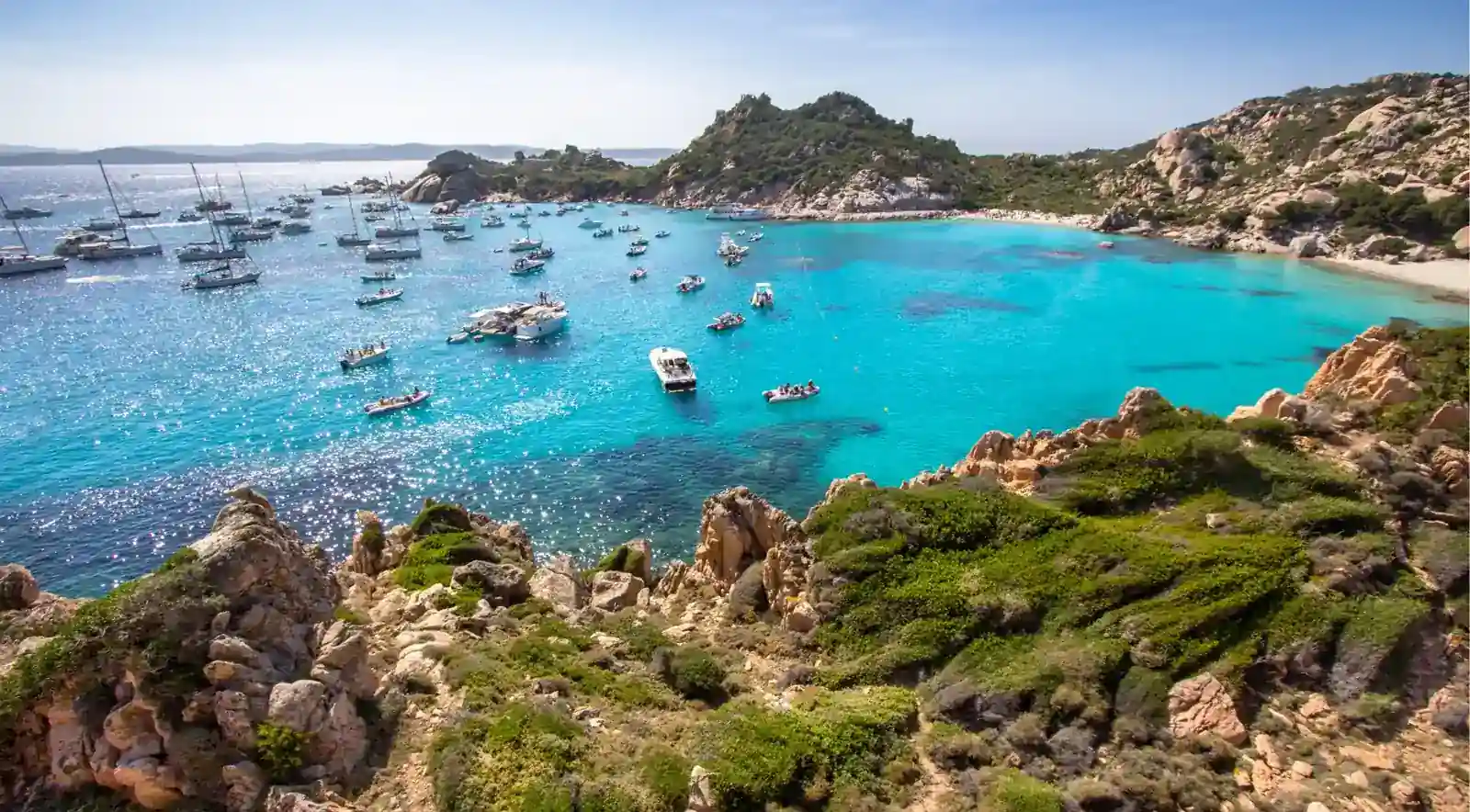
The Story Behind the Pink Sand
From a 1964 Antonioni film to the "hermit of Budelli" — the events that turned a beach into a legend, and got it protected.
The science: what actually makes it pink
The colour comes from Miniacina miniacea, a benthic foraminifer — a single-celled organism that builds a rose-tinted calcareous shell while living among the archipelago's Posidonia oceanica seagrass. When it dies, its shell washes ashore and wave action grinds it together with fragments of coral and white sand, tinting the shoreline pink. Seen from a boat, the effect is a soft blush rather than a saturated colour.
The film that made it famous (1964)
Director Michelangelo Antonioni shot part of Il Deserto Rosso (Red Desert), starring Monica Vitti, on Budelli's pink sand. The film won the Golden Lion at the Venice Film Festival, and its dreamlike beach sequence introduced Spiaggia Rosa to the world.
Decades of sand theft (1970s–1990s)
As word spread, growing numbers of private boats anchored here and visitors took handfuls of pink sand home as souvenirs. Over roughly three decades the cumulative loss was severe enough to visibly fade the beach's famous colour — the direct reason the strict rules exist today.
Mauro Morandi, the hermit of Budelli
In 1989, a former PE teacher named Mauro Morandi was sailing toward Polynesia when his boat broke down near Budelli. The island's caretaker was retiring; Morandi took the job on the spot, sold his boat, and stayed for 32 years, living in a converted WWII shelter and keeping the beach clean. He was moved off the island in April 2021 and died on 3 January 2025, aged 85.
Protection today: Zone A and the buoy line
Budelli became publicly owned in 2016 after the Italian state blocked a private sale, and the beach now sits inside Zone A of the La Maddalena Archipelago National Park — the park's strictest protection tier. Boats must stay outside a buoy line roughly 70 metres offshore; landing, swimming and anchoring are forbidden year-round.