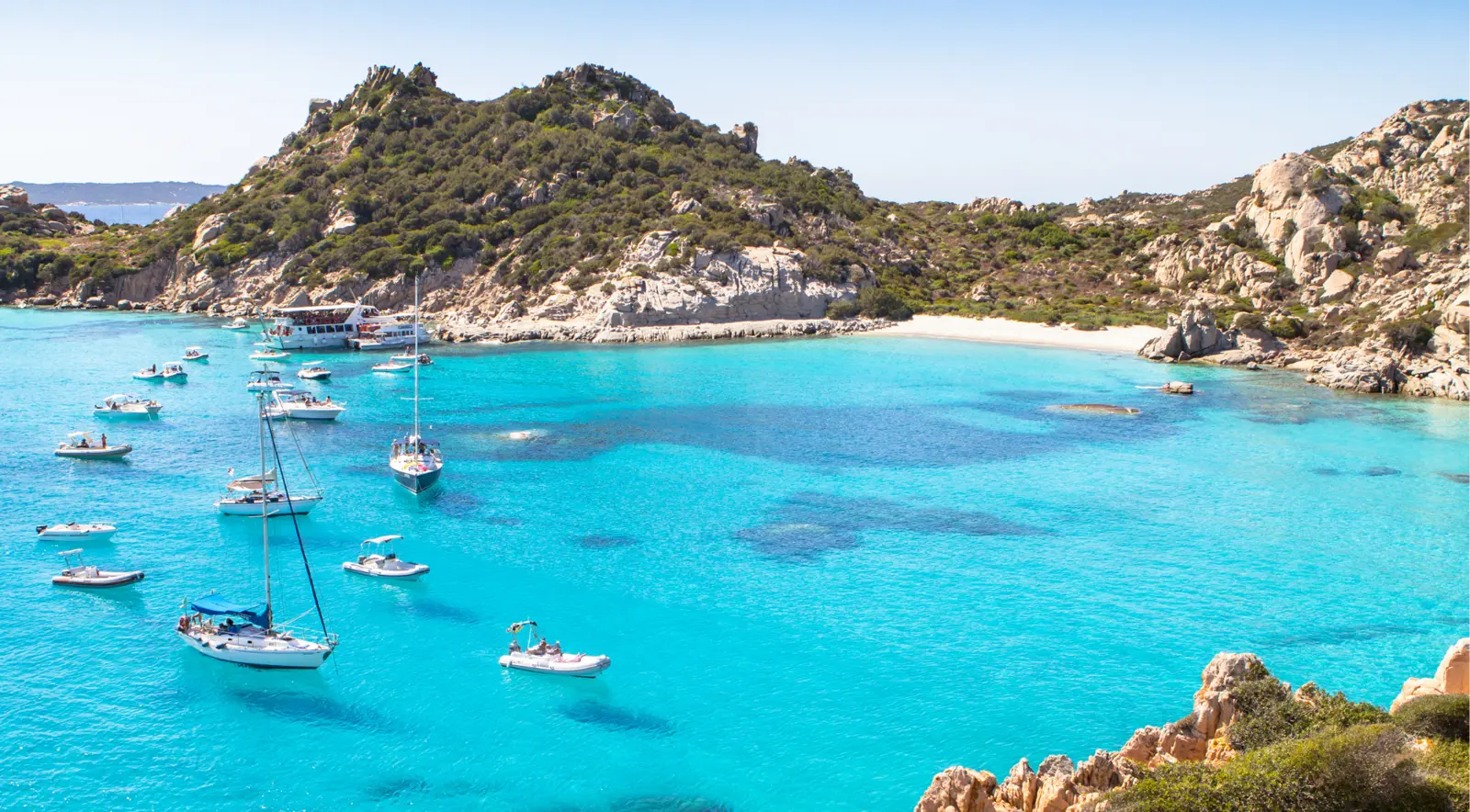
Boats moored off the white sand and turquoise water of Cala Corsara on Spargi island, La Maddalena
Spargi Island · Boat-only · 2026 guide

Cala Corsara, Spargi Island: The Complete Guide to Sardinia's Most Beautiful Beach

A cluster of four powder-white coves on the wild southern coast of Spargi, judged "Italy's most beautiful beach" by Tripadvisor in 2016 — with a pirate legend, a 2,000-year-old Roman shipwreck offshore, and no road in sight. Only boats reach it, from about $58.

4.6–4.9/5 across 10,400+ reviews of tours that stop at Spargi

Boat-only, no roads Free 24-hour cancellation
  • 4 covesmake up Cala Corsara
  • 4.2 km²size of Spargi Island
  • 120–100 BCage of the offshore Roman wreck
  • €2.50–€5national park fee per person
  • From $58boat tours that stop here
Spargi Island and its most famous cove · 2026

A Granite Jewel Accessible Only by Sea

There are beaches that photograph well, and then there is Cala Corsara — a place that makes even seasoned sailors cut the engine, drift, and simply stare. Tucked into the wild southern coast of Spargi Island in Sardinia's La Maddalena Archipelago, Cala Corsara is a cluster of powder-white sand coves where the sea shifts from milky white to turquoise, emerald and deep cobalt within a few metres. It is reachable only by boat, has no bars, no sunbeds and no roads — and that is precisely why it was judged "Italy's most beautiful beach" by Tripadvisor in 2016 and included by Forbes magazine among the seven Italian beaches that deserve to be visited in 2018.

Spargi itself is the third-largest island in the archipelago: roughly 4.2 square kilometres with about 11 kilometres of coastline, almost circular in shape and completely uninhabited. Its highest point, Punta di Guardia Preposti, rises 153 metres above the sea, and the whole archipelago has been protected as the Parco Nazionale dell'Arcipelago di La Maddalena since 4 January 1994. The island also carries 20th-century military history — several WWII fortifications survive, including the Zavagli battery, built in 1912 directly behind Cala Corsara.

Best tour for Cala Corsara & Spargi · 2,200+ reviews Free cancellation
Best tour for Cala Corsara & Spargi · 2,200+ reviews

From Palau: La Maddalena Boat Tour, 4 Islands in One Day

From $66 4.6 (2,200+ reviews) ~7 hours Free 24-hour cancellation

Why we recommend it: its own itinerary names sunbathing at "Cala Granara or Cala Ferrigno at Spargi Island" as a stop, aboard the newest boat in the Palau fleet, with live guide translation in four languages.

Sea conditions decide which of Spargi's coves the skipper anchors at that day. Check live dates and book below.

Check live availability and prices for this tour on GetYourGuide. Роwered by GetYourGuide.

The Beach's Full Story

The wreck on Secca Corsara

The Roman Shipwreck, by the Numbers

A 2,000-year-old cargo vessel discovered by a local diver and excavated in one of the earliest scientific underwater digs.

  • 18 mdepth of the wreck on Secca Corsara
  • 35 mlength of the Roman cargo vessel
  • 1939discovered by diver Lazzarino Mazza
  • 1958first excavation, led by Nino Lamboglia
Worth adding to your itinerary

Other Experiences You Might Enjoy

If Cala Corsara is the reason you booked, build the rest of the day around the archipelago's other highlights.

Most travellers pair a Cala Corsara swim stop with the rest of a full-day La Maddalena Archipelago boat tour from Palau — a viewing of Budelli's Pink Beach from the water, a swim at the Porto della Madonna natural pools, and sunbathing at Santa Maria. A catamaran or sailing tour adds a proper Sardinian lunch with wine on board, while a small-group RIB tour is the surest way to also reach the wilder coves around Razzoli.

For the rest of the archipelago, dedicate a separate day to La Maddalena town and Caprera — Garibaldi's island — and see our guide to the best beaches in Sardinia and the archipelago for the full rundown of swimmable coves.

Folklore, archaeology and a pirate legend

The Story Behind Cala Corsara

Granite formations with names, a Neolithic trading stop, and the corsairs who gave the cove its name.

  1. The beach in detail: four coves, not one

    Cala Corsara lies at the extreme south of Spargi, in a broad bay sometimes nicknamed "Pirate Bay." What looks on a map like a single beach is in fact a cluster of four small white-sand coves, divided from one another by granite outcrops and backed by low dunes covered in juniper, broom, wild roses and sea lilies. The sand is exceptionally fine, white and almost powdery; the seabed is mostly sandy, producing luminous colour gradations.

  2. The Witch's Rock, the Bulldog and the Boot

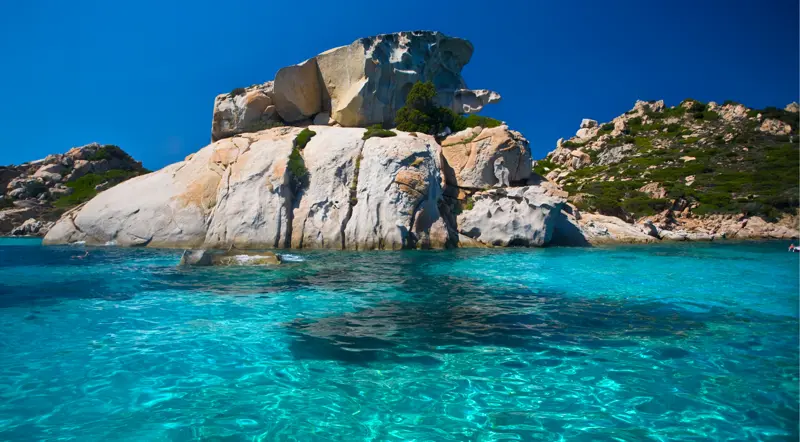
    Cala Corsara's granite formations are the stuff of folklore. The Roccia della Strega ("Witch's Rock") sits on a rocky spur to the left of the main beach. Nearby, visitors spot the "Bulldog" — a hollow rock resembling a bulldog's head — and "Lo Stivale" ("the Boot"), a wind-carved stone echoing the shape of the Italian peninsula.

  3. A Neolithic trading stop

    Inside a granite tafone on the central beach, archaeologists found Neolithic remains — pottery and obsidian — testifying that Spargi was a stopover on ancient obsidian trade routes long before it became a pirate hideout.

  4. Snorkelling at Cala Corsara

    Water shoes are strongly advised among the granite and over the Posidonia meadows. Expect schools of salema (Sarpa salpa), saddled bream (Oblada melanura), Mediterranean rainbow wrasse (Coris julis) and ornate wrasse (Thalassoma pavo), along with octopus, starfish and sea urchins.

  5. The Roman shipwreck of Spargi

    On the shoal known as Secca Corsara, at about 18 metres depth, lies the Spargi wreck — a Roman nave oneraria (cargo vessel) roughly 35 metres long that sank around 120–100 BC. Its cargo included amphorae of the Dressel 1 type (Dressel 1A and 1B), standard Late-Republican wine amphorae from the Campania region. Discovered in 1939 by La Maddalena diver Lazzarino Mazza, the wreck was excavated from 1958 by pioneering underwater archaeologist Nino Lamboglia — a milestone dig, the first to be mapped using a grid and photomosaic techniques. Recovered items are conserved at the Museo Archeologico Navale "Nino Lamboglia" in La Maddalena, currently closed for restoration, with a tender published in early 2026.

  6. Pirates, corsairs and the name "Cala Corsara"

    The name comes from the Italian corsaro — corsair or pirate. Local tradition holds that the cove was once a pirates' lair, hidden from the open western approach yet with a commanding view of the Strait of Bonifacio. Barbary corsair raids in the region peaked in the 16th century, enduring from the Middle Ages into the 18th century.
See Tours That Stop at Cala Corsara

Beyond Cala Corsara

Spargi's Other Coves

All of Spargi's beaches sit on the eastern and southern coasts, sheltered from the prevailing Mistral, and every one is accessible only by sea.

South-eastern coast

Cala Granara

Vegetated dunes, fine pale sand and a shallow sandy seabed make this an easy entry point — one of the most beautiful coves on the island.

Named after a Persian empress

Cala Soraya

Originally Cala Ciaccaro, renamed for Soraya Esfandiary-Bakhtiary, second wife of Shah Mohammad Reza Pahlavi, who reportedly loved to anchor her yacht in this brilliant white sand arc.

"Cove of Love"

Cala Conneri

Also called Cala dell'Amore, this is the most intimate spot on Spargi — two small beaches of fine white sand hemmed by pink-tinged granite, among the least crowded even in August.

North-east coast

Cala Canniccio / Cala Ferrigno

Amber-coloured sand with a small jetty in the north-east — the sunbathing stop named in several Palau tour itineraries alongside Cala Granara.

North, west & sheltered

Cala d'Alga, Cala Pietranera & Cala Piscioli

Cala d'Alga and Cala Pietranera sit on the northern coast, Cala Piscioli to the west — quieter still, and rarely mentioned by name on standard tour routes.

Getting there and timing it right

How to Visit Cala Corsara

Boat tour, self-charter or a well-timed early start — here's what actually works.

Boat tours from Palau

The main gateway, with a crossing of roughly 35–45 minutes. Full-day archipelago tours include a 1–2 hour swimming stop at Cala Corsara and/or Cala Granara as part of a wider route.

Boat tours from La Maddalena town

A shorter crossing of about 20–30 minutes to Spargi, useful if you're already based on the island rather than in Palau.

Self-charter

A national park permit is required (online via PagoPa); sailing boats receive a 40% discount. Spargi's waters are Zone Mb (general protection) — anchor on sand or rock only, never on Posidonia, and check current overnight anchoring ordinances before sailing.

Timing

Cala Corsara fills fast — calm and near-empty first thing, "stormed by boats" by midday in peak summer. Go early morning or late afternoon for both the crowds and the light.

The boats that actually stop at Spargi

The Best Boat Tours That Visit Cala Corsara

Sea conditions decide the exact cove each day, but every one of these names a Spargi swim stop in its route.

Our top pick · best-selling full-day group boat

The Spargi Tour We Recommend Starting With

The most-reviewed La Maddalena tour on the platform stops at Budelli's natural pools and Santa Maria, then continues to Spargi for a swim and snorkel stop — from $58, with free cancellation.

Best-selling archipelago tour · 5,900+ reviews Free cancellation
Best-selling archipelago tour · 5,900+ reviews

From Sardinia: La Maddalena Archipelago Full-Day Boat Tour

From $58 4.6 (5,900+ reviews) ~7 hours Free 24-hour cancellation

Why we recommend it: 4.6 stars across 5,900+ reviews, a multilingual guide on board, and swim/snorkel stops at Budelli, Santa Maria and Spargi in the same day.

Depart Palau or La Maddalena, swim at Budelli's natural pools, sunbathe at Santa Maria, then snorkel at Spargi before free time in La Maddalena town.

  • Swim & snorkel stop at Spargi (Cala Corsara area)
  • Additional stops at Budelli's natural pools and Santa Maria
  • Free time in La Maddalena's historic centre
  • Multilingual guide commentary on board
  • Departs Palau or La Maddalena town

National Park landing fee (€2.50–€5, cash) paid at check-in. Check live dates and book below.

Ready to book?

Check availability & prices

Free 24-hour cancellation · reserve now, pay later

Most comfortable · catamaran with lunch · 2,200+ reviews

From Palau: La Maddalena Archipelago Catamaran Tour with Lunch

From $1884.9 (2,200+ reviews)

The catamaran's shallow draft (roughly 1.15 m) lets it anchor closer to Spargi's smaller coves than deeper-keeled boats, and the captain chooses among three island stops based on wind and sea conditions, with a full Sardinian lunch and wine included.

Check availability
Small-group & flexible · RIB tour · 500+ reviews

Palau or La Maddalena: 4-Hour RIB Tour of the Archipelago

From $544.8 (500+ reviews)

A fast, flexible half-day on a certified skipper's RIB with swim stops chosen on the day — the most likely format to reach Spargi's quieter coves beyond Cala Corsara when conditions allow. See our full Razzoli & natural pools guide for more on this route.

Check availability
Light, viewpoints and the wildlife around Spargi

Photography Guide & Wildlife

What to shoot, when to shoot it, and what shares the water and sky with you.

Wind-sculpted granite rock formations rising from clear water at Spargi, near Cala Corsara

Best light: early morning, when the east-facing coves catch the morning sun, or late afternoon for warm granite tones. Best viewpoints: from the water on approach, from the headlands above, and from the beach itself. What to shoot: the Witch's Rock, the water colour over the sandy seabed, and white sand against pink-tinged granite. Drones are forbidden over the national park without prior written authorisation from the park authority.

Below the surface: Posidonia oceanica meadows, salema, saddled bream, wrasse, octopus and starfish. Seabirds on the nearby Spargiotto islet: Cory's shearwater, Yelkouan shearwater, European storm petrel, Audouin's and Corsican gull, European shag and Eleonora's falcon. Marine mammals: bottlenose and striped dolphins pass through the Pelagos Sanctuary waters that include this stretch of coast.

Before you go

Practical Information

Fees, timing and the one thing most first-timers forget to pack.

Getting there

Olbia airport is about 45 minutes from Palau; from there, if you're staying on La Maddalena island, the Palau–La Maddalena ferry takes 15–20 minutes.

Best time & sea temperature

June and September are the sweet spot; the sea is swimmable May through October, ranging roughly 18–26°C.

National park fee

€2.50 per person in the shoulder months, or €5.00 from June to August, paid in cash on board.

What to bring

Swimsuit, snorkel, water shoes, sunscreen, hat, water and cash — there's no bar, no lifeguard, no toilets and no shade beyond a few junipers.

Wild boar warning

Don't bring food onto the beach: Spargi's wild boars will raid unattended bags left on the sand.

All park rules, fees and anchorage regulations current as of 2026 but subject to change. Verify at lamaddalenapark.it before you travel.

Common questions

Cala Corsara: Frequently Asked Questions

The pirate history, the Roman wreck, the park fee and the best time to go — answered.

Why is it called Cala Corsara?

The name comes from the Italian corsaro, meaning corsair or pirate. Local tradition holds the cove was once a pirates' lair, hidden from the open western approach yet with a commanding view over the Strait of Bonifacio. Barbary corsair raids in the region peaked in the 16th century and continued from the Middle Ages into the 18th century.

Can you drive to Cala Corsara?

No. Spargi Island is uninhabited and has no roads or ferries — Cala Corsara is reachable only by boat, either on a full-day archipelago tour from Palau (about 35–45 minutes) or from La Maddalena town (about 20–30 minutes), or by a self-chartered, permitted boat.

What is the national park fee at Cala Corsara?

The La Maddalena Archipelago National Park fee is €2.50 per person in the shoulder months or €5.00 per person from June to August, paid in cash on board. Sailing boats and catamarans on a self-charter permit receive a 40% discount over motorboats.

What is the Roman shipwreck near Cala Corsara?

On the Secca Corsara shoal, at about 18 metres depth, lies the wreck of a Roman cargo vessel roughly 35 metres long that sank around 120–100 BC carrying Dressel 1 wine amphorae from Campania. Discovered in 1939 by local diver Lazzarino Mazza, it was excavated from 1958 by underwater archaeologist Nino Lamboglia in one of the first digs to use grid-mapping and photomosaic techniques. Recovered artifacts are held at the Museo Archeologico Navale "Nino Lamboglia" in La Maddalena, currently closed for restoration.

When is the best time to visit Cala Corsara?

June and September give warm, swimmable water (18–26°C) with far thinner crowds than midsummer. Within any day, go early morning or late afternoon — Cala Corsara is calm and near-empty first thing but fills up fast, "stormed by boats" by midday in peak season.

Do wild boars really come onto the beach at Cala Corsara?

Yes. Spargi's wild boar population will raid unattended bags left on the beach, so the standard advice is not to bring food ashore or to keep it closely watched. The beach also has no bar, no lifeguard, no toilets and no shade beyond a few junipers.

Ready to see it for yourself?

Book a Boat Tour That Stops at Cala Corsara

Compare full-day group boats, catamarans and small-group RIBs that swim and snorkel at Spargi — and pair it with the Pink Beach viewing, the natural pools and Santa Maria the same day.

  • Free cancellation up to 24 hours
  • Reserve now, pay later
  • 4.6–4.9★ across 10,400+ reviews

See La Maddalena Boat Tours

We may earn a commission if you book through links on this page, at no extra cost to you.